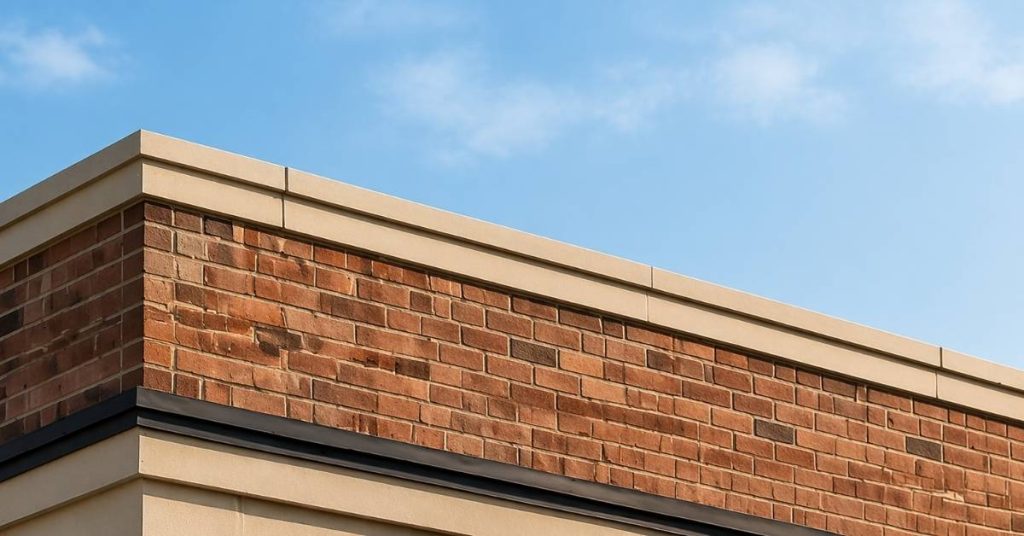
Bricks may look similar from a distance, but they are not all the same size. Their length, width, and height can change depending on the type, manufacturer, and intended use.
Understanding brick dimensions is helpful when repairing a wall, replacing damaged bricks, planning a fireplace, or starting a new masonry project. The correct size helps the new brickwork match the existing wall and keeps mortar joints even.
This homeowner guide explains standard sizes, common brick types, mortar spacing, and the key measurements to check before buying bricks. You can also explore our brick masonry services for brick repair, replacement, and installation.
What Are Brick Dimensions?
The dimensions of a brick are measured in three directions:
- Length: The longest side of the brick
- Width: The distance from the front face to the back
- Height: The vertical thickness of the brick
Measurements may be written in different orders, depending on the supplier. Some list length first, while others use depth, height, and length. Always check the product description before ordering.
In the United States, a common modular brick measures approximately 7 5/8 inches long, 3 5/8 inches wide, and 2 1/4 inches high before mortar is added.
What Are Standard Brick Dimensions?
The term standard brick dimensions can be confusing because there is more than one common brick size.
A standard non-modular brick often measures:
8 × 3 5/8 × 2 1/4 inches
A modular brick commonly measures:
7 5/8 × 3 5/8 × 2 1/4 inches
The difference in length may seem small, but it affects wall spacing, mortar joints, material calculations, and the final appearance.
Modular bricks are slightly shorter because their size is designed to work with a mortar joint. Once the mortar is included, the brick and joint fit into an easy planning measurement of about eight inches.
Common Brick Dimensions Chart
The following chart shows typical measurements used for several brick styles in the United States.
| Brick type | Typical brick dimensions in inches |
|---|---|
| Modular | 7 5/8 × 3 5/8 × 2 1/4 |
| Standard | 8 × 3 5/8 × 2 1/4 |
| Queen | 7 5/8 × 2 3/4 × 2 3/4 |
| Engineer | 8 × 3 5/8 × about 2 3/4 |
| Utility | 11 5/8 × 3 5/8 × 3 5/8 |
| Roman | 11 5/8 × 3 5/8 × 1 5/8 |
| Norman | 11 5/8 × 3 5/8 × 2 1/4 |
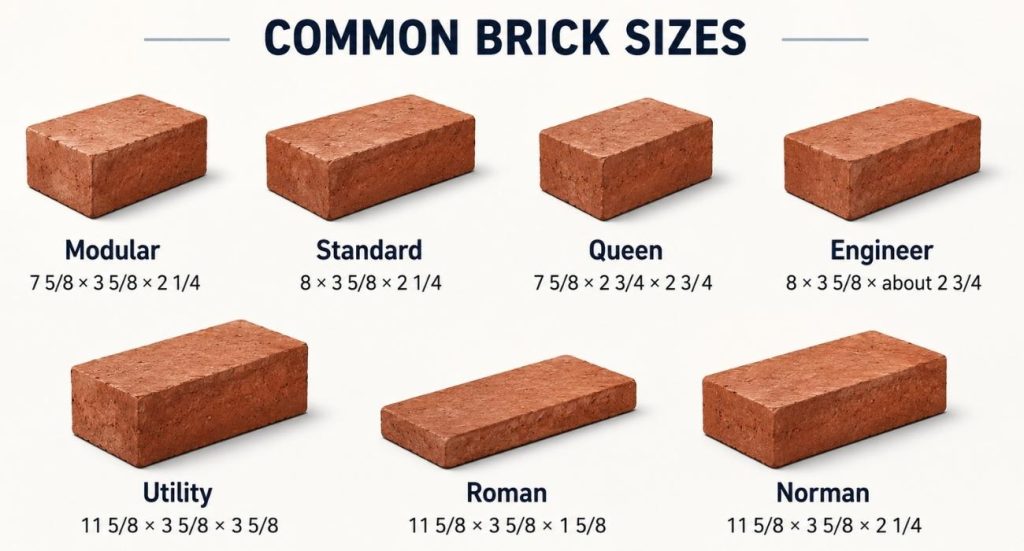
These are general industry measurements. Actual brick dimensions can vary slightly between manufacturers, product lines, and local suppliers. Always measure a sample brick before placing a large order.
Actual, Specified, and Nominal Brick Size
Homeowners often find several different measurements listed for the same brick. This happens because brick sizes may be described as actual, specified, or nominal.
Specified Brick Dimensions
Specified dimensions are the planned measurements used in drawings, product orders, and construction documents. They describe the intended size of the brick without the mortar.
Actual Brick Dimensions
The actual dimensions are the physical measurements of the finished brick. Clay bricks can shrink slightly during firing, so the final measurement may differ a little from the specified size. Minor differences between individual bricks are also possible.
Nominal Brick Dimensions
Nominal measurements include the brick and its expected mortar joint. For example, a modular brick measuring 7 5/8 inches long works with a 3/8-inch mortar joint to create a nominal length of eight inches. This makes wall layouts and opening sizes easier to plan.
How Mortar Changes Brick Measurements
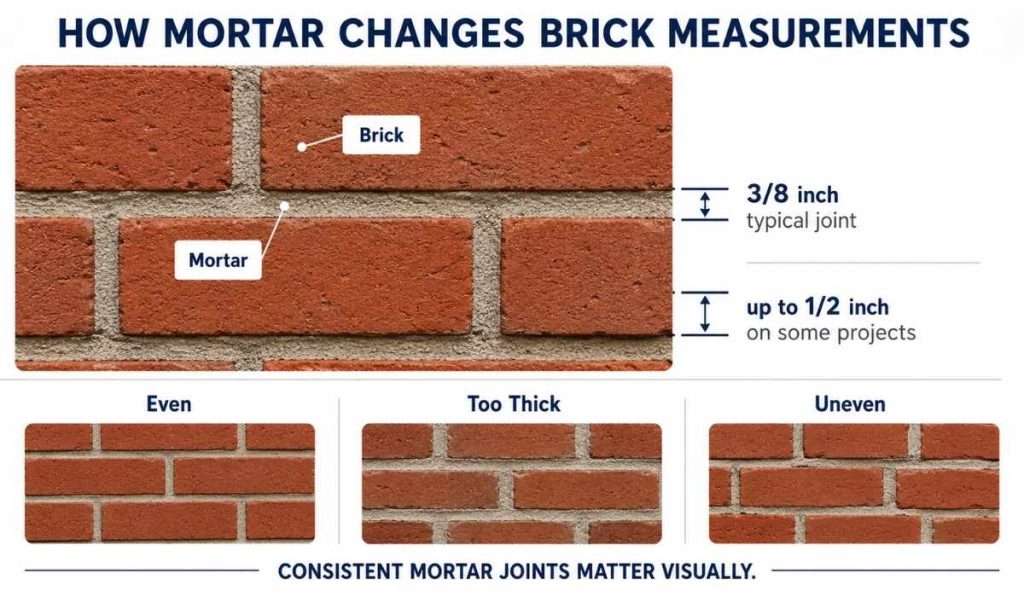
A brick wall is not measured using bricks alone. Mortar joints take up space between each unit and affect the total height and length of the finished wall. A common mortar joint is approximately 3/8 inch thick, although some projects may use joints closer to 1/2 inch.
Joint thickness can change due to:
- The style of the brick
- Differences in brick size
- The condition of an older wall
- The selected masonry pattern
- The finish requested by the homeowner
Mortar joints should remain reasonably consistent. Joints that are too thick, too thin, or uneven can make the wall look poorly matched and may affect its long-term performance.
Modular Brick Dimensions
Modular brick dimensions are designed to create simple, predictable wall measurements once mortar is added.
A common modular brick measures:
7 5/8 × 3 5/8 × 2 1/4 inches
With a typical mortar joint, it fits into a planned length of eight inches. This makes modular bricks convenient for exterior walls, home additions, commercial buildings, and many masonry repairs. Their predictable size also helps contractors plan corners, doors, windows, and wall openings with fewer cuts.
Standard Brick Dimensions
Standard bricks are close in appearance to modular bricks, but they are usually slightly longer.
Common brick dimensions in inches for a standard brick are:
8 × 3 5/8 × 2 1/4 inches
Because the brick already measures eight inches long before mortar is included, it does not follow the same modular spacing as a 7 5/8-inch brick. The term “standard” does not mean that every brick sold under this name has identical dimensions. Confirm the manufacturer’s measurements before using standard bricks for repairs or extensions.
Queen Brick Dimensions
Queen bricks are usually taller and narrower than common modular bricks. A typical queen brick measures:
7 5/8 × 2 3/4 × 2 3/4 inches
The larger front face allows fewer bricks to cover a wall. This can reduce the number of units and mortar joints required. However, queen bricks may not match the proportions of an older wall built with standard or modular bricks. Their appearance should be checked carefully before using them for a visible repair.
Engineer Brick Dimensions
Engineer bricks are taller than regular modular or standard bricks. A common engineer brick is around:
8 × 3 5/8 × 2 3/4 inches
These bricks may be selected for projects that need greater strength, lower water absorption, or improved resistance to harsh conditions. They can be used around foundations, retaining walls, basements, and other demanding locations. However, the performance rating and material properties matter more than size alone.
Utility, Norman, and Roman Bricks
Larger or longer bricks can create a different wall appearance and may reduce the number of pieces needed.
Utility Bricks
Utility bricks commonly measure:
11 5/8 × 3 5/8 × 3 5/8 inches
Their larger face covers more space than a standard brick. This can help speed up installation on large walls.
Norman Bricks
Norman bricks are long but have a height similar to regular modular bricks:
11 5/8 × 3 5/8 × 2 1/4 inches
They create longer horizontal lines and can give a building a wider, more modern appearance.
Roman Bricks
Roman bricks are long and thin:
11 5/8 × 3 5/8 × 1 5/8 inches
They are often chosen for their low, stretched appearance rather than for matching typical residential brickwork.
What Are Average Brick Dimensions?
The phrase average brick dimensions is often used during early project planning.
A simple rounded estimate is about:
8 inches long × 4 inches wide × 2 to 2 2/3 inches high
This estimate may include part of the mortar spacing and should not be used to order materials. For accurate planning, measure the actual brick and the mortar joint separately. Even a small difference can become noticeable across a long wall.
Why Brick Size Matters During Repairs
Using the wrong size replacement brick can make a repaired area stand out.
A brick that is too short may require an unusually thick mortar joint. A taller brick may force the contractor to use thinner joints or cut nearby units. These changes can disturb the original pattern.
A proper repair should consider:
- Brick length, width, and height
- Color and surface texture
- Mortar color and joint profile
- Wall pattern or bond
- Age and condition of the existing masonry
In older New York City properties, the original brick may no longer be available. A masonry contractor may need to compare several samples or source reclaimed bricks to achieve a close match.
How Brick Dimensions Affect Wall Appearance
Brick size changes the number of horizontal and vertical joints visible on a wall.
Smaller bricks create more joints and a more detailed pattern. Larger bricks create fewer joints and can make a wall appear simpler and broader. Long bricks, such as Norman or Roman styles, emphasize horizontal lines. Taller bricks, such as queen or engineer units, create fewer courses across the same wall height.
The selected brick must also work with the bond pattern. Running bond, common bond, Flemish bond, and stack bond arrange bricks differently, which affects cuts, joint locations, and the final design.
How Many Bricks Are Needed Per Square Foot?
The amount depends on the face size of the brick, mortar joint thickness, and wall pattern.
A wall built with common modular bricks usually needs around six to seven bricks per square foot when mortar joints are included. Larger bricks generally require fewer units because each brick covers more wall area. This is only a planning estimate. Contractors also add extra bricks for cuts, corners, breakage, and future repairs.
The amount of waste may increase when the wall has:
- Several windows or doors
- Curved sections
- Decorative patterns
- Many corners
- Mixed brick sizes
- Damaged areas requiring careful removal
How to Measure an Existing Brick
Measure the wall before buying replacement bricks.
First, measure the length, height, and visible depth of one full brick. Avoid measuring a broken or heavily damaged unit. Next, measure the mortar joint above and beside the brick. Record both measurements separately.
For a more accurate result, measure a group of ten bricks and the joints between them. Divide the total measurement by ten. This helps reduce errors caused by small differences between individual bricks. Take clear photographs and bring the measurements to the supplier. A physical sample is even more helpful when matching an old wall.
How to Choose the Right Brick Size
Start by considering the type of project. For an existing wall repair, match the original dimensions as closely as possible. Color alone is not enough. For a new wall, modular bricks are a practical choice because they work well with predictable mortar spacing.
Larger bricks may reduce the number of units and installation time, but they also change the wall’s appearance. Decorative bricks should be viewed as samples before making a final decision. Also consider local building requirements, weather exposure, moisture resistance, and the condition of the supporting wall.
Frequently Asked Questions
What are the most common brick dimensions?
A common modular brick measures 7 5/8 × 3 5/8 × 2 1/4 inches. A standard non-modular brick is often 8 × 3 5/8 × 2 1/4 inches.
Are all bricks the same size?
No. Brick dimensions vary by type, manufacturer, country, and intended use.
Does brick size include mortar?
The actual or specified size normally describes the brick alone. The nominal size includes the expected mortar joint.
What is the normal mortar joint size?
A 3/8-inch mortar joint is common, although some walls use joints closer to 1/2 inch.
Can different brick sizes be used on the same wall?
They can be used for planned decorative designs, but mixing sizes during an ordinary repair may create uneven joints and a poor visual match.
Final Thoughts
Understanding brick dimensions makes it easier to plan repairs, estimate materials, and select bricks that fit the existing wall. Always check the actual brick and mortar measurements instead of relying only on general size names.
For brick replacement, wall repair, or other professional masonry services in New York City, contact Royal Builder NYC for an inspection and project estimate.
Need Help with Your Next Project? Call Royal Empire Builder Today!
Fast responses. Expert advice. Trusted service across NYC and beyond.