If you own a rowhouse, brownstone, or flat-roof extension anywhere in Brooklyn, Queens, the Bronx, Staten Island, or Manhattan, chances are you’ve dealt with a flat or low-slope roof at some point. And if a roofer ever mentioned “mod bit” to you, they were talking about modified bitumen roofing — one of the most popular flat roof systems used across NYC today.
In this guide, we’ll break down what modified bitumen roofing is, how it’s installed, what it costs, and why it’s such a common choice for NYC’s older row houses, walk-ups, and commercial buildings.
What Is Modified Bitumen Roofing?
Modified bitumen roofing is an asphalt-based roofing material that’s been reinforced with fiberglass or polyester and mixed with rubber or plastic to make it more flexible and durable. Think of it as an upgraded version of old-school tar and gravel roofing (also called built-up roofing, or BUR).
It was first developed in Europe in the 1960s and became common in the U.S. by the mid-1970s. Today, it’s a go-to option for flat roofs and low-slope roofs on brownstones, rowhouses, garages, extensions, and commercial buildings all over the five boroughs.
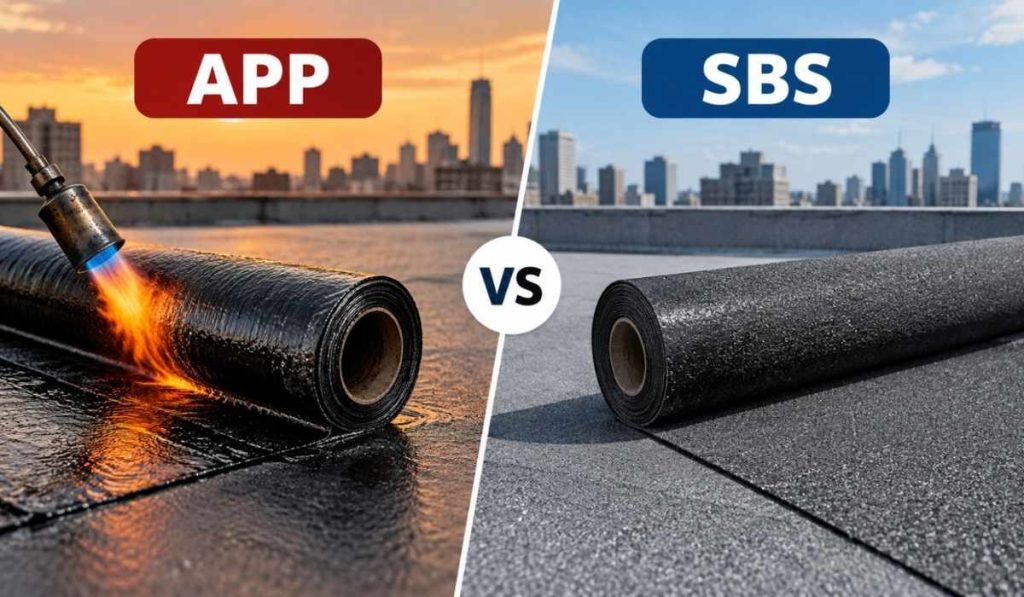
The Two Main Types: APP vs. SBS
Not all modified bitumen roofing is the same. There are two main types, and each works a little differently.
APP Modified Bitumen
APP modified bitumen or Atactic Polypropylene modified bitumen is a plastic-based membrane. It’s stiffer once installed and holds up well in hot weather. It’s usually installed using a propane torch, which melts the underside so it bonds tightly to the roof deck.
SBS Modified Bitumen
SBS modified bitumen or Styrene-Butadiene-Styrene modified bitumen is a rubber-based membrane. It’s more flexible than APP, which makes it a strong choice for NYC’s swings between freezing winters and hot, humid summers. SBS can be installed with a torch, hot asphalt, cold adhesive, or as a peel-and-stick (self-adhered) membrane.
For most NYC homes, where roofs deal with both extreme cold and extreme heat over the course of a year, SBS is often the better fit — though a licensed roofer can tell you which one makes sense for your specific building.
How Is It Installed?
There are four common install methods for modified bitumen roofing:
Torch-Applied
- Torch-applied — A propane torch heats the membrane so it bonds to the roof as it’s rolled out. This is one of the most common methods but requires an experienced installer, since it involves an open flame.
Hot-Mopped
- Hot-mopped — Hot liquid asphalt is used to bond the layers together, similar to old BUR roofing.
Cold-Applied
- Cold-applied — No flame or heat involved. An adhesive is spread on the roof, and the membrane is rolled directly into it.
Self-Adhered
- Self-adhered (peel-and-stick) — The membrane already has adhesive built in, so no torch or hot asphalt is needed.
On older NYC buildings — especially wood-frame rowhouses — many roofers lean toward cold-applied or self-adhered methods to cut down on fire risk. That said, torch-applied is still widely used and, when done correctly by an experienced crew, is completely safe.
Why Modified Bitumen Roofing Works Well in NYC
It Holds Up to NYC Weather
It holds up to NYC weather. Between freezing winters, humid summers, and everything in between, a flat roof in New York takes a beating. Modified bitumen roofing is built to expand and contract with temperature changes instead of cracking.
It Handles Foot Traffic
It handles foot traffic. A lot of NYC flat roofs double as rooftop decks, storage space, or access points for HVAC units. Modified bitumen is tear-resistant and holds up better under foot traffic than some other flat roof options.
It’s Easier to Repair Than You’d Think
It’s easier to repair than you’d think. Leaks and punctures are usually easy to find and patch without tearing off the whole roof — a big plus for older buildings where a full replacement can get expensive.
It Can Help With Energy Costs
It can help with energy costs. A reflective, or “cool roof,” coating can be applied to the top layer to cut down on heat absorption, which can help lower cooling costs in the summer.
It’s a Solid Long-Term Investment
It’s a solid long-term investment. A properly installed modified bitumen roof typically lasts 15 to 25 years, and sometimes longer with regular maintenance.
Modified Bitumen vs. Other Flat Roof Options
If you’re comparing flat roof systems, here’s roughly how modified bitumen stacks up against the other common choices:
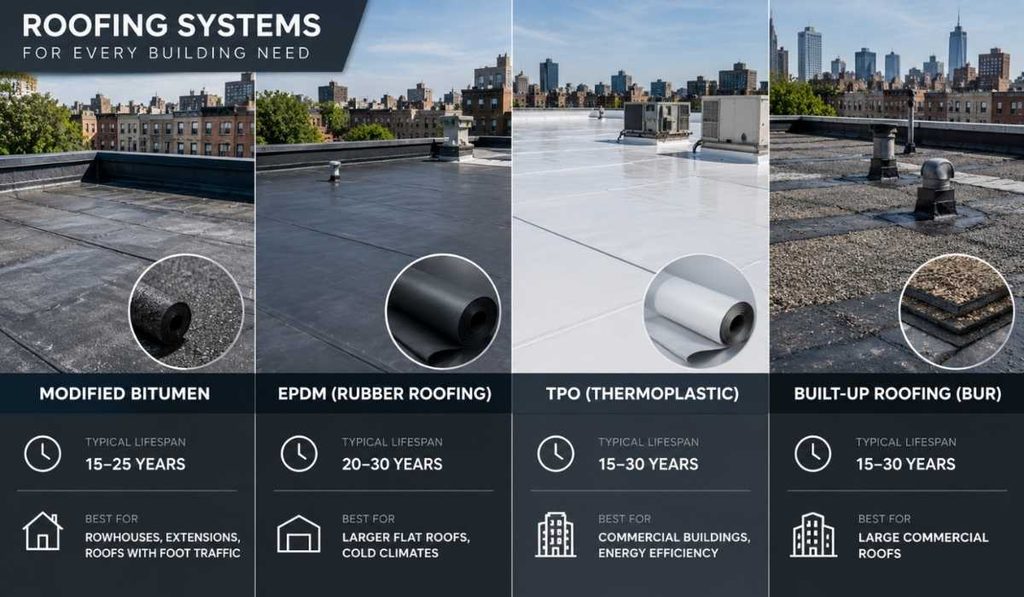
| Roofing System | Typical Lifespan | Best For |
|---|---|---|
| Modified Bitumen | 15–25 years | Rowhouses, extensions, roofs with foot traffic |
| EPDM (rubber roofing) | 20–30 years | Larger flat roofs, cold climates |
| TPO | 15–30 years | Commercial buildings, energy efficiency |
| Built-Up Roofing (BUR) | 15–30 years | Large commercial roofs |
Modified bitumen tends to land in a sweet spot for NYC homeowners — it’s durable, handles foot traffic well, and is generally more budget-friendly than a full multi-ply BUR system.
What Does Modified Bitumen Roof Installation Cost?
For a typical residential flat roof, modified bitumen roofing installation in the NYC area generally runs in the $4 to $8 per square foot range, including materials and labor. The exact cost depends on a few things:
- How many layers (plies) your roof needs
- Which install method is used (torch-down, cold-applied, self-adhered)
- The condition of your existing roof deck
- Access to the roof (rowhouses with tight lot lines can add labor time)
A licensed roofing contractor can give you an accurate quote after inspecting your roof in person.
Signs Your Modified Bitumen Roof Needs Repair or Replacement
- Blistering or bubbling on the surface
- Cracking or splitting in the membrane
- Bare spots where the top layer has worn away
- Ponding water that doesn’t drain after a rainstorm
- Leaks that keep coming back after repairs
If you’re noticing any of these signs, it’s worth getting a professional inspection before a small issue turns into a bigger, more expensive one.
Get a Modified Bitumen Roofing Estimate in NYC
Whether you’re dealing with a leaky rowhouse roof in Brooklyn or need a full flat roof replacement on a multi-family building in Queens, our team at Royal Empire Builder NYC has the experience to get the job done right. We work across all five boroughs and can walk you through the best roofing option for your building, your budget, and your timeline.
Contact us today for a free roof inspection and estimate.
Frequently Asked Questions
What Is Modified Bitumen Roofing Used For?
It’s mainly used on flat and low-slope roofs — think rowhouses, brownstone extensions, garages, and commercial buildings. It works well on roofs with a pitch of 2/12 or less.
What’s the Difference Between APP and SBS Modified Bitumen?
APP is plastic-based, stiffer, and torch-applied — better suited for hot climates. SBS is rubber-based, more flexible, and can be installed several different ways, making it a strong choice for areas with big temperature swings, like NYC.
How Long Does Modified Bitumen Roofing Last?
With proper installation and regular maintenance, most modified bitumen roofs last 15 to 25 years.
Can Modified Bitumen Be Installed Over an Existing Roof?
Sometimes, if the existing roof is in good shape and the structure can handle the extra weight. A roofer will need to check local building code requirements first.
Is Modified Bitumen Roofing Better Than TPO?
It depends on the project. Modified bitumen holds up better to foot traffic and is generally easier to repair. TPO tends to be more energy-efficient and is often used on larger commercial roofs. Both can be great options when installed correctly.
Need Help with Your Next Project? Call Royal Empire Builder Today!
Fast responses. Expert advice. Trusted service across NYC and beyond.